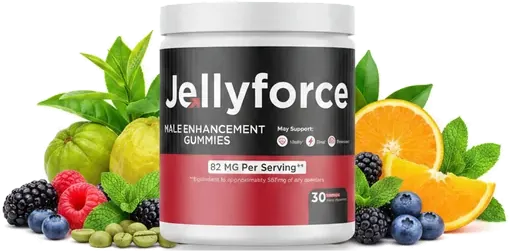
How Does Jelly Force Work? Five Botanicals, Graded One by One
Jelly Force does not publish how it works. Its one label claim is a "may support" line, and no amount is printed for any ingredient. Of its five named botanicals, L-arginine has the most human research, maca some, ashwagandha a little, and muira puama and catuaba almost none at the doses involved.
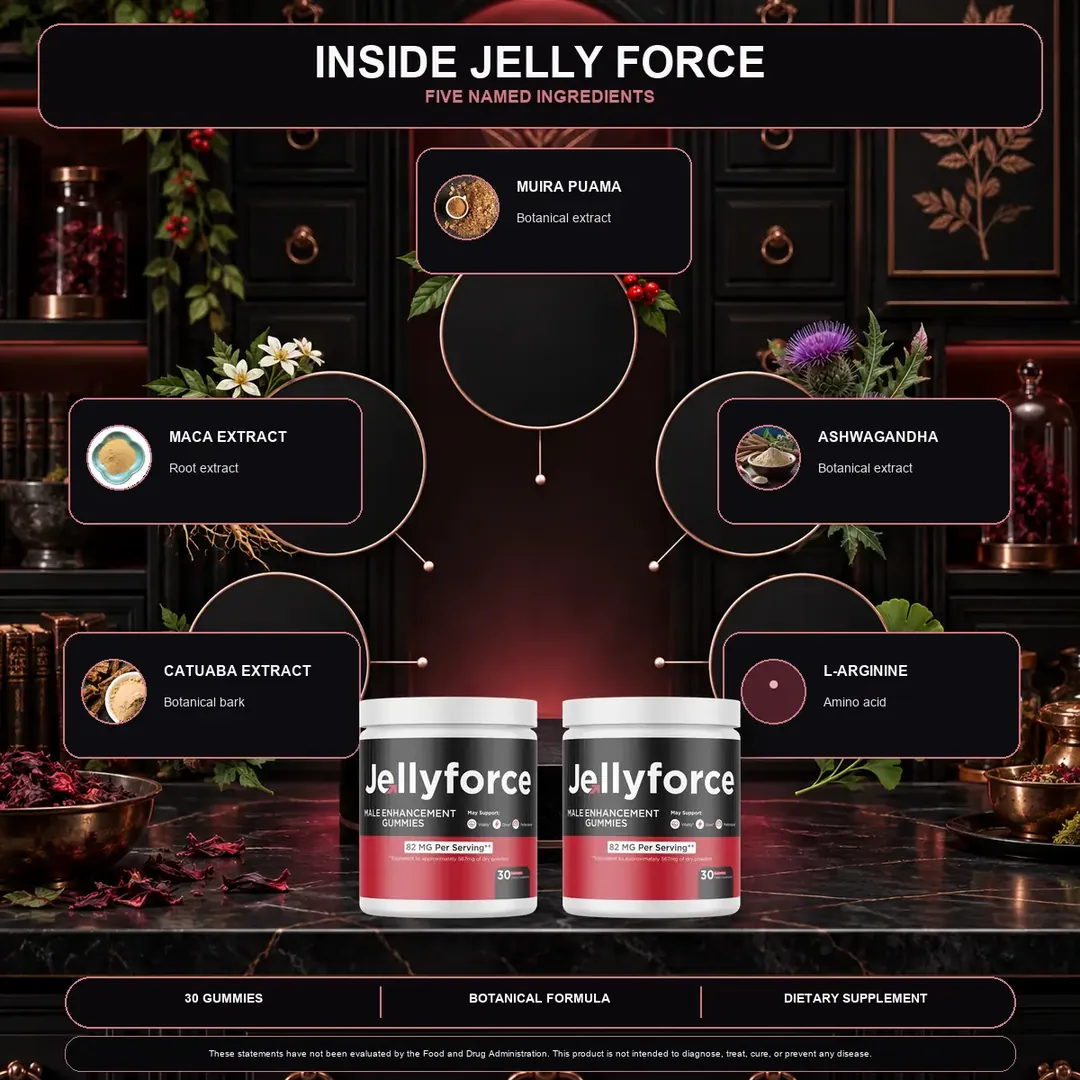
Key facts
Ask how Jelly Force works and the honest first answer is: the maker does not say. There is no mechanism on the jar. There is a list of plant names and one number.
So we did what any careful buyer would do. We took the five names that every source agrees on and asked what human research exists for each. Then we held the whole 567 mg serving up against those trial doses.
Key facts in short
- The five names in every source: muira puama, maca, catuaba, ashwagandha and L-arginine.
- The whole serving is 82 mg of extract, footnoted as about 567 mg of dry-powder equivalent, shared by all ingredients.
- Trial doses: maca 1,200 to 3,000 mg a day; L-arginine 1,500 to 5,000 mg; muira puama 500 to 1,500 mg; ashwagandha 300 to 600 mg a day.
- L-arginine has the strongest research of the five, rated moderate. Maca and ashwagandha are rated limited. Muira puama and catuaba are rated weak.
- No amount is published for any ingredient, so the label cannot be matched to any trial.
- It is a supplement, not a treatment for erectile dysfunction.
Related searches this page answers: does jelly force actually work, does jelly force gummies work, does jellyforce work, how does jellyforce work, is jellyforce worth it, jelly force does it work.
Does each of the five ingredients work?
Here is the evidence in one view. The grades are the ones the research summary gives, and "dose" means the daily amount used in the trials, not what is in a gummy.
| Ingredient | Trial dose a day | Evidence | What the research measured |
|---|---|---|---|
| L-arginine | 1,500 to 5,000 mg | Moderate | Blood vessel function and erectile function |
| Maca | 1,200 to 3,000 mg | Limited | Sexual desire and function, in small trials |
| Ashwagandha | 300 to 600 mg | Limited | Stress, sleep and some male fertility markers |
| Muira puama | 500 to 1,500 mg (commonly cited) | Weak | Almost nothing: no single-ingredient human trial found |
| Catuaba | No studied dose exists | Weak | No human efficacy study to point to |
Read the table in two steps. First, ask whether any human evidence exists. Second, ask whether the amount in a gummy could match it. The label only lets you do the first step.
How is L-arginine meant to work?
L-arginine is an amino acid that the body uses to make nitric oxide, a signal that relaxes blood vessels. A pooled analysis of ten randomized trials found it improved self-reported erectile function compared with placebo (Srivatsav and colleagues, Sexual Medicine Reviews, 2021). The trials used doses of 1,500 to 5,000 mg a day, and the clearest benefit came at 5 g.
The same blood-vessel effect is why it is not harmless for everyone. It lowers blood pressure and should not be mixed with nitrate drugs without a doctor. In the VINTAGE MI trial, people recovering from a heart attack who took 9 g a day had higher deaths, and the trial was stopped early (VINTAGE MI trial, JAMA, 2006). A gummy is nowhere near 9 g. The lesson is narrower: this ingredient is not gentle for everyone, and our medicine guide covers who should ask first.
What do maca, ashwagandha, muira puama and catuaba add?
Maca. A systematic review and a later meta-analysis found some positive pooled results, and both rated the evidence too limited for firm conclusions (Shin and colleagues, maca systematic review, 2010; Lee and colleagues, maca meta-analysis, 2023). Trials ran about 8 to 12 weeks.
Ashwagandha. The one randomized trial built for sexual performance gave 600 mg a day of a standardized extract to 50 healthy men for 8 weeks (Chauhan and colleagues, ashwagandha trial, 2022). It also carries a rare liver-injury signal in published case reports (LiverTox entry on ashwagandha).
Muira puama. No controlled human dose-response trials exist. The most-cited human data point is an uncontrolled observational study of 262 men over 2 weeks.
Catuaba. The most careful study found that much commercial catuaba is a different bark, and the extracts tested showed no effect in the standard tissue test (Kletter and colleagues on catuaba, Planta Medica, 2004).
Does one gummy hold a trial dose?
Take the most generous reading: the full 567 mg of dry-powder equivalent, with the entire amount given to one ingredient at a time. That is the best case, and it still leaves gaps.
| Ingredient | Low end of trial range | 567 mg as a share of that low end |
|---|---|---|
| L-arginine | 1,500 mg | about 38% |
| Maca | 1,200 mg | about 47% |
| Muira puama | 500 mg | about 113% |
| Ashwagandha | 300 mg | about 189% |
Now the catch. That 567 mg is shared by every ingredient in the gummy. For illustration only, an even five-way split would be about 113 mg each. Nothing printed says the split is even. So for L-arginine and maca, one gummy falls short even in the best case. For muira puama and ashwagandha, whether a gummy gets near a trial dose depends on a split nobody publishes.
So does Jelly Force really work?
We cannot say, and neither can the label. There is no study of this product. There are studies of some of its ingredients, at amounts the label never confirms. A weak mechanism plus an unknown dose is not a result.
Also remember what a quick, strong effect would suggest. In this category, FDA has found undeclared prescription drugs, which act fast and hard. A slow gummy at 82 mg should not. We hold no test result for this jar and make no claim about it. We only say that a sudden, drug-like effect belongs in a doctor's office, not in a five-star post.
Frequently asked questions
How does Jelly Force work?
The maker does not publish a mechanism. The only label claim is a soft "may support" line. The research we can cite concerns its named ingredients, not this finished gummy.
Does Jelly Force really work?
No study of this product is published. Some ingredients have human research at amounts far above what one gummy could hold if the 567 mg were shared out, and the label does not show the split.
Which Jelly Force ingredient has the best evidence?
L-arginine, rated moderate, with trial doses of 1,500 to 5,000 mg a day. Maca and ashwagandha are rated limited. Muira puama and catuaba are rated weak.
Is Jelly Force effective for men with erectile problems?
It makes no such claim and is not a treatment for erectile dysfunction. Erectile difficulty can be an early sign of heart disease or diabetes, so see a doctor first.
Is Jelly Force worth it, given the evidence?
That depends on what you value. The evidence is thin and amounts are unpublished. The 60-day refund window limits the money risk, but it says nothing about results.
Why do trial doses matter so much?
Research results belong to the dose tested. A trial at 1,200 mg of maca says nothing about a gummy that may hold a small share of 567 mg. Without amounts, the research cannot be applied.
Our view
The kindest reading of Jelly Force is a gentle, low-dose botanical gummy. The label gives you no way to confirm even that. The harshest reading is that it borrows the credit of research done at far higher doses. The truth sits between them, and the missing panel is why we cannot place it.
If you try it, treat it as a small experiment with an exit. Do not take more than the label says, do not expect a prescription-like effect, and see a doctor about any symptom that matters to you.
Last updated . Written by the Jellyforcefit Editorial Desk. Medically reviewed by Dr. Meetal Mehta, Physician, on , for accuracy against the label and the cited sources. A doctor or pharmacist should answer questions about your own health. Jelly Force is a supplement and has not been approved by FDA.