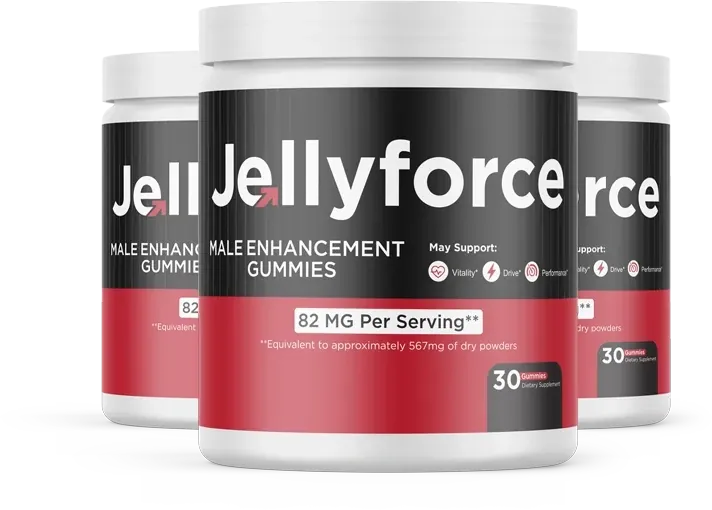
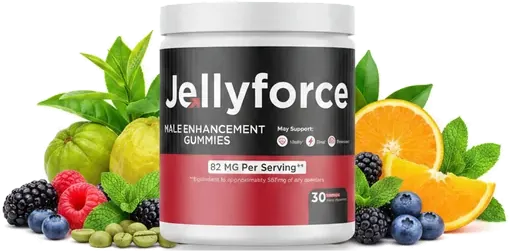
Jelly Force testing and quality marks, explained
Jelly Force artwork carries eight marks: FDA Registered Facility, GMP Certified, Non-GMO, Natural Ingredients, Gluten Free, Dairy Free, Doctor Formulated and Manufactured in USA. Each describes something. None is independently verifiable from what we hold: no certificate number, auditor, certifying body or clinician is named. Third-party testing, especially a screen for undeclared pharmaceuticals, is what would actually settle the question a seal cannot.
A wall of marks, and what stands behind each one
A jar can carry eight marks and still hand a buyer nothing they can check. Jelly Force artwork shows a small wall of seals: a facility registration, a manufacturing-practice claim, a non-GMO badge, a natural-ingredients flag, two allergen marks, a doctor-formulated stamp and a country-of-origin claim. Seen together, they read like a stack of certifications. Read one at a time, most of them describe rather than certify.
This page goes through each mark, what it actually means, and what it stops short of proving. Then it covers what real third-party testing looks like, and why one specific test matters more here than the seals in front of it.
The eight marks on the artwork
FDA Registered Facility
The plant is on the FDA facility register. Registration is a listing, not an approval, and Jelly Force is not FDA-approved.
GMP Certified
Good Manufacturing Practice rules are claimed. No certificate number or auditing body is published beside the mark.
Non-GMO
A non-GMO mark from the seller artwork. No certifying organisation is named next to it.
Natural Ingredients
A marketing mark with no legal definition behind it. Natural does not mean tested, dosed or safe.
Gluten Free
A gluten-free mark from the artwork. We hold no allergen statement from the jar itself.
Dairy Free
A dairy-free mark from the artwork, again with no allergen line we can check.
Doctor Formulated
A marketing mark. No clinician is named anywhere in the material we were given, so treat it as unverified.
Manufactured in the USA
A mark from the artwork. The jar itself prints no country of manufacture that we can read.
Marks describe. They do not endorse, and none of the eight carries a certificate number, an auditor, a certifying body or a named clinician that we could find printed anywhere alongside it.
What each mark claims, and what it leaves open
The most useful way to read a seal wall is column by column: what the mark claims, and, separately, what it stops short of claiming. Laid out that way, most of the gaps are the same size.
| Mark | What it claims | What it does not establish |
|---|---|---|
| FDA Registered Facility | The plant appears on FDA's facility register | Approval. FDA does not approve facilities, and registration is a listing requirement, not an inspection result printed on the seal |
| GMP Certified | Good Manufacturing Practice rules are followed | No certificate number or auditing body is published beside the mark, so nobody outside the company can look the certification up |
| Non-GMO | The product is free of genetically modified ingredients | No certifying organisation is named, so there is no third party to check the claim against |
| Natural Ingredients | The ingredients are natural in some sense | "Natural" has no legal definition on a US supplement label. It says nothing about dose, purity or testing |
| Gluten Free / Dairy Free | The product does not contain gluten or dairy | No allergen statement from the jar itself backs either mark up in the material we hold |
| Doctor Formulated | A doctor was involved in the formula | No clinician is named anywhere in the material we were given |
| Manufactured in USA | The product is made domestically | The jar itself prints no country of manufacture that we can read |
FDA registration: a listing, not a stamp of safety
Registering a facility with FDA is closer to filing an address than passing an inspection. FDA itself warns consumers that a claim of manufacture in an "FDA-approved facility" is meaningless, because FDA does not approve facilities (U.S. et al., 2026). A registered plant can also make products that are later found adulterated; registration and contamination are not mutually exclusive.
Jelly Force is not FDA-approved, and no dietary supplement is. FDA does not pre-approve supplements the way it approves prescription drugs. The distinction matters because a registration mark, printed in the same visual language as a certification badge, is easy to misread as far more than it is. A shelf full of these marks can look, at a glance, like the same kind of trust signal a nutrition panel or a lab report would provide. It is not the same kind of thing, and treating it that way is the mistake this page is trying to head off.
GMP and "Natural Ingredients": one missing certificate, one missing definition
GMP Certified, with no certificate to check
Good Manufacturing Practice is a real regulatory framework covering how a facility handles cleanliness, recordkeeping and process control. Claiming GMP compliance is common, and often true. What is missing here is anything that lets a buyer confirm it: no certificate number, no named auditor and no certifying body appear next to the mark on the artwork we hold.
"Natural Ingredients" is a marketing phrase
Unlike GMP, this one is not a regulatory standard with a missing certificate. It is a phrase with no legal definition on a US supplement label at all. FDA specifically cautions that terms like "herbal" or "all natural" do not guarantee safety (U.S. et al., 2026). A jar can be entirely natural in every ordinary sense of the word and still carry no published dose, no consistent ingredient list, and no test behind it.
"Doctor Formulated": the mark with no doctor attached
"Doctor Formulated" is the mark that implies the most and discloses the least. It suggests a named clinician stood behind the recipe, checked the doses, and signed off on the combination. Nothing in the material we hold names that person: no clinician, no credential, no specialty, and no statement of what "formulated" actually meant in practice.
Treat it the way you would treat any unattributed claim: as marketing language until a name and a credential show up behind it. We have never seen one for this product, and a mark with no name behind it is not evidence one way or the other. It is simply unverifiable, the same as the certificate number missing from the GMP mark next to it.
What real third-party testing actually looks like
Every mark above is self-applied artwork. Real third-party testing looks different in a specific way: an independent lab, with no financial stake in the sale, tests an actual sample and publishes a result the seller did not write.
- A named, accredited lab, not the brand's own quality team
- Identity testing confirming each ingredient is the plant or compound claimed
- Potency testing showing how much of each active is actually present
- Heavy metal, microbial and pesticide screening against a published limit
- A batch or lot reference tying the result to the specific jar in question
- A screen for undeclared pharmaceutical drugs, not only for the labelled botanicals
None of that exists for Jelly Force in the material we hold or could find published. The full anatomy of a real certificate, and why the lot and CoA references printed for this product fall short of one, is on the batch verify page.
Why an undeclared-drug screen matters more here than almost anywhere
Of every test a real certificate could run, one would actually reassure a buyer in this category: a screen for undeclared sildenafil, tadalafil and their analogues. FDA runs a standing public-notification programme because sexual-enhancement supplements keep turning up with exactly those drugs hidden inside them (U.S. et al., 2026). None of the eight marks on this jar tests for that. A non-GMO badge, a gluten-free flag and a facility registration all leave that specific question completely untouched.
We have no test result for Jelly Force and are not alleging anything about it. The point is that a seal wall, however full, is not a substitute for the one screen that matters most in this specific category. More on the category pattern is on hidden drug ingredients.
Testing & Quality: common questions
What does "FDA Registered Facility" actually mean?
The plant is listed on FDA's facility register. It is not an approval, and FDA does not approve facilities at all.
Is Jelly Force GMP certified?
The artwork claims it. No certificate number or auditing body is published to check that claim against.
Does "Natural Ingredients" mean it is safe?
No. The phrase has no legal definition on a US label and says nothing about dose, purity or testing.
Who is the doctor behind "Doctor Formulated"?
No clinician is named anywhere in the material we hold. Treat the mark as unverified.
Is Jelly Force FDA approved?
No. No dietary supplement is FDA approved to treat, cure or prevent anything.
What would real third-party testing show?
Identity and potency for each ingredient, contaminant screening, and, for this category specifically, a test for undeclared pharmaceutical drugs.
Why does an undeclared-drug screen matter more for this product category?
Sexual-enhancement supplements are the category the FDA flags most often for undeclared sildenafil, tadalafil or similar drugs. A test for that is the one thing that would actually settle the question.
Has Jelly Force been tested for undeclared drugs?
We hold no such test result, and none is published anywhere we could find.
Keep reading
Batch and CoA verify
Why lot JEL-26/JE-5563 and the CoA reference are draft labels, not lab proof.
Read →Hidden drug ingredients
The FDA record for sexual-enhancement supplements, explained without alleging anything about this product.
Read →The missing supplement facts
No panel exists for this product. Here is what one would normally show.
Read →Order Jelly Force from the authorized retailer
60 servings per bottle, 1 to 2 droppers a day. Kits of 2, 3 or 6 bottles run from $49 a bottle on the sales page, with a 60-day money-back guarantee. Questions first? Call +1 (302) 200-3480.