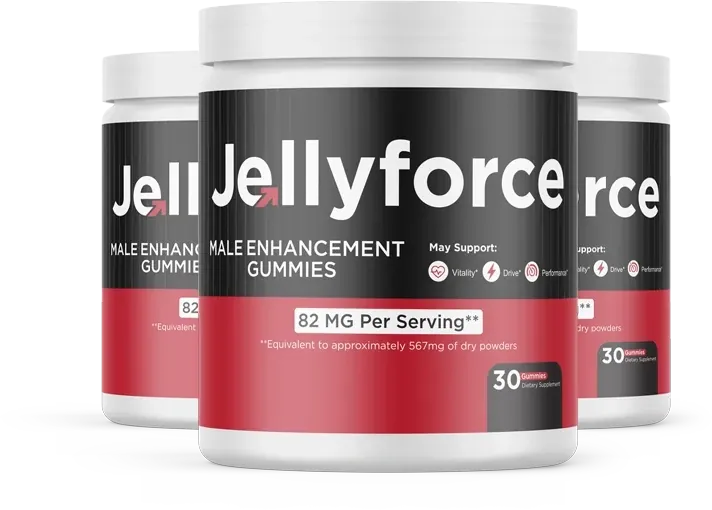
How Does Jelly Force Work? The Role of Each Ingredient
Jelly Force combines named botanicals, each studied for its own effect, with L-arginine for blood flow.
Maca is studied for desire, ashwagandha for stress and well-being, and L-arginine for raising nitric oxide to widen blood vessels.
Meet the five named ingredients one at a time.
What the mechanism story actually says, and does not say
"How it works" usually means a manufacturer's explanation of mechanism. This page is not that. It is what the published research actually says each named ingredient is studied for, told against what this specific product can and cannot be shown to do.
Two separate questions run through everything below: what a mechanism is plausible for, and what dose that mechanism was actually studied at. A real mechanism at the wrong dose is not a working product.
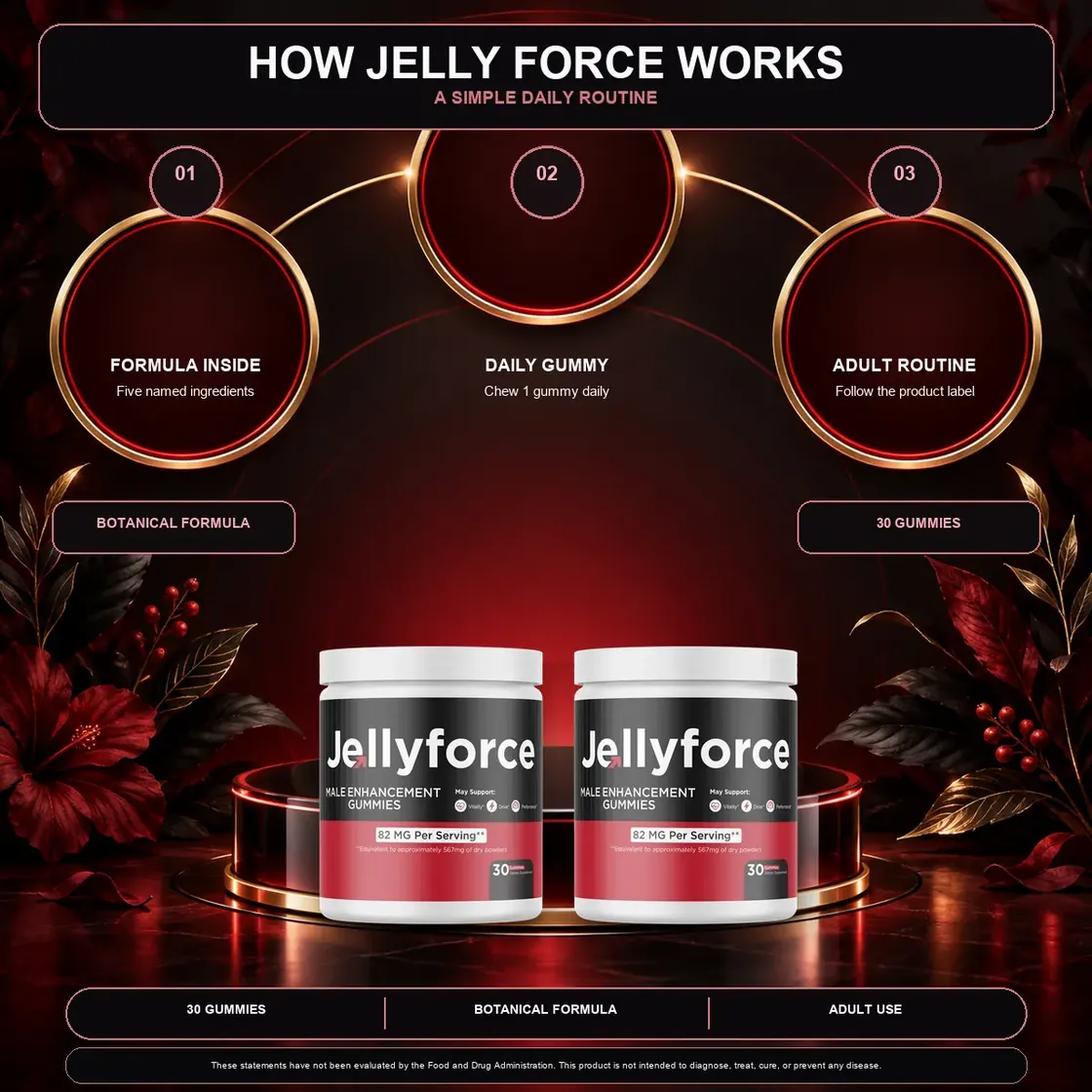
Seller artwork, and what it actually claims
The seller's own explanation
This artwork is the seller's own description of how the formula is meant to work. It is marketing material, not a clinical claim, and it is not verified by any trial of the finished product. It names the same broad ideas covered in more detail below: blood flow, energy, and traditional botanical use.
The rest of this page checks those ideas against the actual published research on each ingredient, and against how this specific jar's undisclosed amounts compare to the doses that research used.
What each ingredient is actually studied for
| Ingredient | What it is studied for | Mechanism, if any is proposed |
|---|---|---|
| L-Arginine | Erectile function, blood flow, endothelial health | Converted by the body into nitric oxide, which relaxes blood-vessel walls and increases blood flow. The clearest, most direct mechanism on this label. |
| Maca | Sexual desire and function, energy | No single accepted biological mechanism. Proposed effects on hormones and mood have not been confirmed in the trials located. |
| Ashwagandha | Stress, sleep, well-being, some male fertility markers | Traditionally described as an adaptogen, thought to act on the body's stress-hormone response. The mechanism for sexual well-being specifically is not established. |
| Muira Puama | Traditional aphrodisiac use | No confirmed mechanism. A 2021 clinical review states plainly that very limited literature exists on its effect on erectile function at all. |
| Catuaba | Traditional aphrodisiac use | No confirmed mechanism, and the most rigorous study located found no effect in the standard tissue model used to test it. |
Only one row on this table has a mechanism most researchers would agree on. The rest are traditional uses with thin or absent human confirmation. More detail on each is on the ingredient breakdown.
The one mechanism with real biology behind it, and why dose still matters
L-arginine and nitric oxide, in plain terms
L-arginine is an amino acid the body converts into nitric oxide, a signaling molecule that tells the smooth muscle in blood-vessel walls to relax. Relaxed vessels widen, and wider vessels carry more blood. That is the same pathway prescription PDE5 inhibitors act on, further downstream.
The mechanism is real. The question is dose. A pooled meta-analysis of ten randomized trials found L-arginine improved erectile-function ratings against placebo Srivatsav et al., 2021, and in one of the trials behind that result, 31% of men taking 5,000 mg a day reported improvement, against 12% on placebo. The trials behind that finding used 1,500 to 5,000 mg a day. Nitric-oxide production is a dose-dependent process: below a certain amount, the body simply does not make enough extra nitric oxide for the effect to show up.
Jelly Force's entire serving, every ingredient combined, is printed at 82 mg of extract, or at most 567 mg read as dry-powder equivalent. L-arginine's own undisclosed share of that total is smaller again. A real mechanism does not produce a real effect below the dose where it has been shown to work.
The mechanism dose, against the whole jar
| Ingredient | Dose used in the research above | Whole jar serving, most generous reading |
|---|---|---|
| Maca | 1,200–3,000 mg a day | 567 mg, for all five ingredients combined |
| L-Arginine | 1,500–5,000 mg a day | 567 mg, for all five ingredients combined |
| Muira Puama | 500–1,500 mg a day | 567 mg, for all five ingredients combined |
| Ashwagandha | 300–600 mg a day | 567 mg, for all five ingredients combined |
| Catuaba | No studied dose exists | 567 mg, for all five ingredients combined |
Every row on the left comes from research on one ingredient alone. Every row on the right is the entire jar, all five ingredients together, read in the most generous way possible: as 567 mg of dry-powder equivalent rather than the 82 mg of extract actually printed. No single ingredient's undisclosed share of that total can reach the low end of its own studied range, because the whole serving does not reach it either. The arithmetic behind this is covered in more depth on the missing Supplement Facts panel.
The other four: thinner evidence, thinner mechanisms
Maca
Two systematic reviews found only a handful of small, mixed-quality trials. One rated the evidence low-certainty even where a pooled result was positive. No accepted mechanism explains how it might work.
Ashwagandha
One small trial found a sexual well-being benefit at 600 mg a day. The traditional adaptogen framing is plausible in general terms, but no mechanism specific to sexual function has been confirmed.
Muira puama
A clinical review states outright that very limited literature exists on its effect on erectile function, and no single-ingredient human trial has been found. There is no confirmed mechanism to describe.
Catuaba
The most careful study tested catuaba extracts directly in a standard tissue assay and found no effect. Whatever mechanism traditional use assumes, it did not show up at the bench.
What has not been tested: this product, as sold
No trial of this product exists
Everything above is research on individual ingredients, mostly at doses much higher than this jar's entire serving. None of it is a trial of Jelly Force itself, as a finished gummy, at whatever combination of amounts it actually contains. No such trial has been located, and none is claimed on the packaging.
That gap is common across this entire category, not unique to this product. Manufacturers of combination supplements rarely fund a trial of the exact finished formula, because that trial would cost more than the product could recover, and because the individual-ingredient research already exists to point to on a sales page. The result is a familiar pattern: real citations, attached to a product nobody has actually tested as sold.
That gap also means every mechanism discussed on this page is borrowed from research on a single ingredient at a specific, disclosed dose, then applied to a product where the dose of that same ingredient is not disclosed at all. A borrowed mechanism is not the same claim as a demonstrated effect. The mechanism can be entirely real in the literature without this specific jar delivering enough of it to matter.
What the mechanism means for safety, not just effect
L-arginine and blood pressure
Because it works by relaxing blood vessels, L-arginine can lower blood pressure and interacts with nitrate medicines. A trial in people recovering from a heart attack was stopped early on safety grounds at high doses.
If you take heart or blood pressure medicine
Ask a doctor or pharmacist before taking anything sold for sexual performance, including this one. The mechanism that might help is the same one that can interact with those medicines.
New or worsening erectile difficulty can be an early sign of cardiovascular disease. More on interactions and side effects and who this is and is not for.
How It Works: common questions
Does Jelly Force have a proven mechanism of action?
One ingredient, L-arginine, has a well-understood mechanism: it raises nitric oxide, which widens blood vessels. That mechanism is studied at 1,500 to 5,000 mg a day, far above this jar's entire serving of 82 mg.
What is maca studied for?
Sexual desire and function, mostly in small trials. Two systematic reviews found the evidence limited and low-certainty, and no confirmed biological mechanism explains how it might work.
What is ashwagandha studied for?
Stress, sleep and general well-being, with one small trial on sexual well-being specifically at 600 mg a day. It is traditionally described as an adaptogen, but no mechanism specific to sexual function is confirmed.
Does muira puama have a known mechanism?
No. A 2021 clinical review states very limited literature exists on its effect on erectile function, and no single-ingredient human trial has been found.
Does catuaba do anything?
The most careful study of it tested extracts in a standard tissue assay used to check for erectile-relevant activity and found no effect from any preparation tested.
Has Jelly Force itself been tested in a clinical trial?
No trial of this specific product, as a finished gummy, has been found. Everything on this page is research on individual ingredients, at their own studied doses.
Why does dose matter if the mechanism is real?
Because nitric-oxide production, like most biological effects, is dose-dependent. Below the amount shown to work in trials, the same mechanism does not reliably produce the same result.
Is the seller's how-it-works artwork a clinical claim?
No. It is marketing material describing the intended idea behind the formula. It is not backed by a trial of the finished product.
Keep reading
The five named ingredients
What each botanical is, and what the human evidence shows for it, one at a time.
Read →The missing Supplement Facts panel
Why the one number this jar prints cannot be checked against any research dose.
Read →Side effects and interactions
What can go wrong with these ingredients, and who should talk to a doctor first.
Read →Order Jelly Force from the authorized retailer
60 servings per bottle, 1 to 2 droppers a day. Kits of 2, 3 or 6 bottles run from $49 a bottle on the sales page, with a 60-day money-back guarantee. Questions first? Call +1 (302) 200-3480.