What is actually in it: four sources, four different answers
Four published sources describe Jelly Force, and each names a different ingredient list: five names from the retailer pack, six from the sales page, eight from a press release, nine from a label review that adds caffeine. Five names appear everywhere. Five more, including caffeine, appear in one source each. Nobody publishes a panel to settle it, so the jar a buyer receives is the only version anyone can check.
Four sources. Four ingredient lists. No panel to settle it.
Ask what is in Jelly Force and the honest answer is: it depends who you ask. This desk located four separate published descriptions of the formula, and no two of them list the same ingredients. Not one of the four is a Supplement Facts panel. Each is a different account, from a different source, published at a different time.
This page goes through each source in turn: who published it, when, and exactly how it differs from the others. Then it covers the two disagreements that actually matter to a buyer, and what conclusion, if any, can be drawn from all four put together.
Every name, against every source
| Ingredient | 5The retailer pack we work from | 8A brand press release, August 2026 | 9A published label review, 2026 | 6The official sales page we could reach |
|---|---|---|---|---|
| Muira Puama | ✓ | ✓ | ✓ | ✓ |
| Maca | ✓ | ✓ | ✓ | ✓ |
| Catuaba | ✓ | ✓ | ✓ | ✓ |
| Ashwagandha | ✓ | ✓ | ✓ | ✓ |
| L-Arginine | ✓ | ✓ | ✓ | ✓ |
| Korean Red Ginseng | – | ✓ | – | – |
| Tribulus Terrestris | – | ✓ | ✓ | ✓ |
| Horny goat weed (epimedium) | – | ✓ | ✓ | – |
| Green Tea | – | – | ✓ | – |
| Caffeine | – | – | ✓ | – |
Where two sources use different words for the same thing, such as maca root and maca extract, they are counted as one row. Rows shaded dark appear in every source. Rows shaded light appear in exactly one. Nobody publishes a Supplement Facts panel we could check any of this against, and no source gives an amount for a single ingredient.
Every name any published source has attached to this product, and which source names it. A dark row means all four agree. A light row means exactly one source says so and the other three are silent.
Source by source: who said what, and when
Source one: the retailer pack, five ingredients
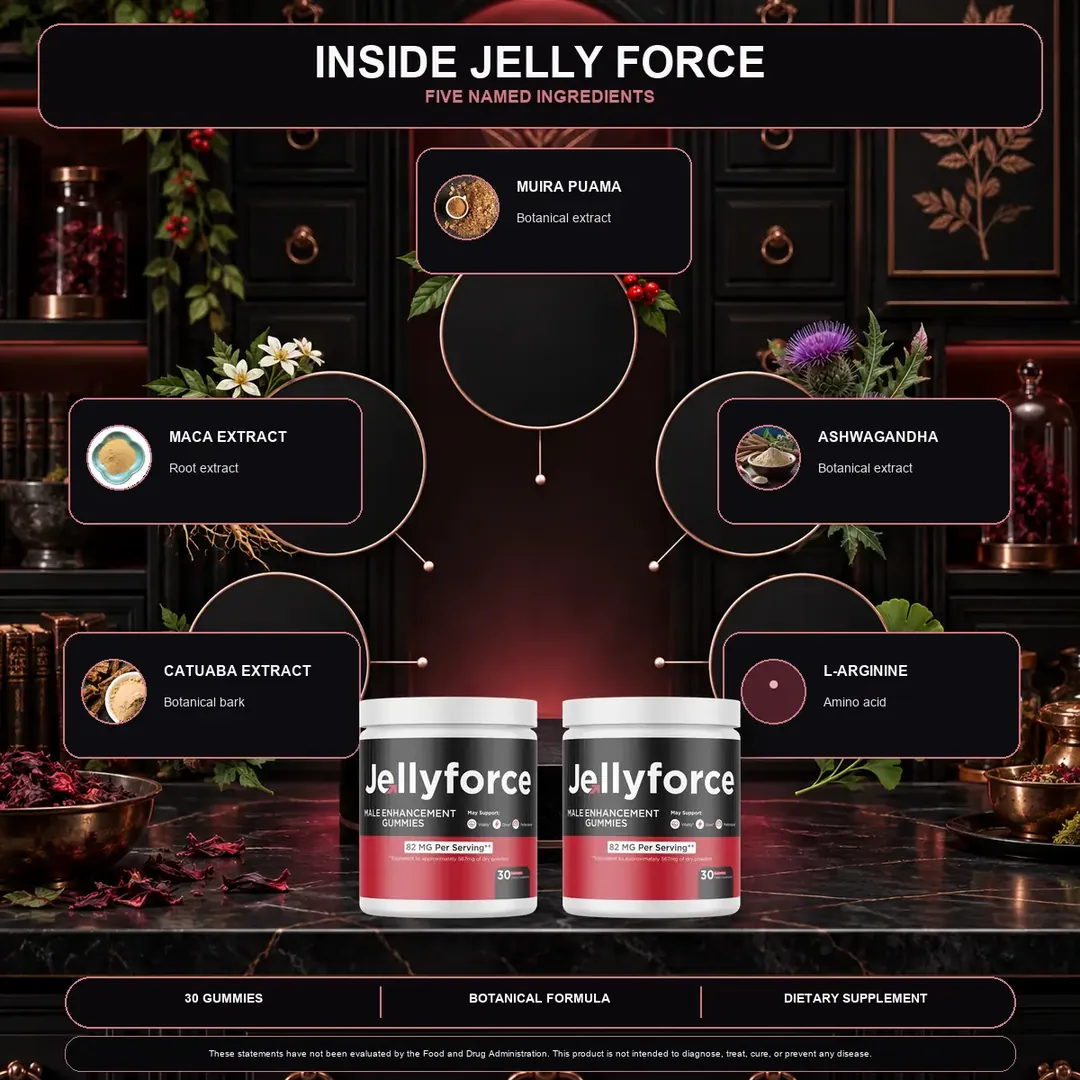
The material this desk works from, and the same five names shown on the seller's own ingredient artwork: muira puama, maca, catuaba, ashwagandha and L-arginine. This is the shortest list, the one printed closest to the product itself, and the baseline every other source either matches or adds to.
Source two: the official sales page, six ingredients
The sales page we could reach names the same five, plus tribulus terrestris. It publishes no Supplement Facts panel, no serving size beyond what the jar itself shows, and no individual amounts. Adding one name without adding any of the numbers a panel would carry is, on its own, not much more informative than the five-name list.
Source three: a brand press release, August 2026, eight ingredients
A press release attributed to the brand adds Korean red ginseng and horny goat weed on top of tribulus, for eight names total. Press releases are marketing copy, written to describe a product favorably, not regulatory filings, and this one does not reconcile itself against the sales page it is supposedly describing.
Source four: a published label review, 2026, nine ingredients
An independently published review of the label goes furthest: it drops Korean red ginseng entirely, and replaces it with green tea extract and 5 mg of disclosed caffeine, while also listing epimedium extract — a plant also known as horny goat weed, but named and treated here as a separate line from the "horny goat weed extract" the press release lists. Its own author flags this as a disagreement with the brand's earlier account, rather than presenting it as settled.
Caffeine: disclosed by one source, absent from three
One of the four sources, the 2026 label review, states the product discloses 5 mg of caffeine. The retailer pack, the sales page and the press release do not mention caffeine at all, in either direction. They do not say it is absent. They simply do not raise it.
This is not a small discrepancy. Caffeine is a stimulant. Some people avoid it entirely for sleep, anxiety, heart rhythm or blood pressure reasons, often on a doctor's advice. A person managing any of those conditions who checks three of the four available sources would reasonably conclude this product has no caffeine in it. The fourth source says otherwise. At 5 mg the amount is small, roughly a twentieth of a cup of coffee, but the right amount to disclose is not the question here. The question is that three sources are silent and one is not, and nobody has reconciled that.
Four names, one source each
Korean red ginseng
Named only by the August 2026 press release. Absent from the retailer pack, the sales page and the label review, which replaces it with green tea instead.
Horny goat weed extract
Named only by the press release, as a distinct line from the label review's separately listed epimedium, even though horny goat weed is a common name for epimedium in the supplement trade.
Epimedium extract
Named only by the 2026 label review, and not by the press release that instead lists a differently worded "horny goat weed extract." Whether these are meant to be the same ingredient or two different ones is not explained by either source.
Tribulus terrestris
Absent from the shortest, retailer-pack list of five, then present in the sales page, the press release and the label review. Three of four sources agree on this one; only the baseline five-ingredient list omits it.
Any one of these four could be in the jar a buyer receives. None of them can be confirmed from the material available, and no source explains why it omits what the others include. This is exactly the kind of gap FDA points to when it warns that sexual-enhancement supplements are the category most often found with undeclared ingredients U.S. et al., 2026: we are not alleging anything about this product, only noting that an inconsistent public record makes a gap like that harder, not easier, to rule out.
What this actually settles, and what it does not
What a buyer can actually conclude
- Muira puama, maca, catuaba, ashwagandha and L-arginine are named by every source located, and are the safest names to treat as probably present.
- No source, of the four, publishes an amount for any single ingredient. This is true regardless of which list is correct.
- The formula, whatever it is, has been described differently at least four times in public, which on its own says something about how carefully this label has been controlled.
What a buyer cannot conclude
- Whether the product contains caffeine. One in four sources says yes; the rest are silent rather than saying no.
- Whether Korean red ginseng, horny goat weed, green tea or epimedium are actually in the jar. Each is named by exactly one source, and one source is not a confirmation.
- How much of anything is present, named by one source or by all four. That number does not exist in any of the material this desk could find.
What actually settles this: the jar itself
The one thing that resolves all of this
Four public descriptions of the same product, disagreeing on a third of their own contents, is not something this desk can settle by picking the source that sounds most official or most recent. None of the four is a Supplement Facts panel, and a press release or a label review is not a substitute for one, however carefully either was written.
There is exactly one document that ends the disagreement, and it is not any of the four sources above. It is the jar in your hand. Whatever it prints, printed at the point of manufacture and sealed inside the packaging, is the only account of the formula that was not written for marketing, a press cycle, or a review article. It is the version you can actually hold up and read.
If your jar carries a Supplement Facts panel this desk does not have on file, or an ingredient list that differs from all four described here, a photograph of it would genuinely resolve something. We would publish it and update every page that depends on this comparison.
Until then, the honest position is the one this whole page takes: report the disagreement, name what each source says, and do not pretend a guess is a fact. More on why there is no panel to check any of this against and what the five core names actually are.
What Is Actually In It: common questions
Why do different sources list different ingredients for Jelly Force?
This desk found four published descriptions of the formula: a retailer pack naming five ingredients, the official sales page naming six, a brand press release naming eight, and a published label review naming nine. None of them is a Supplement Facts panel, and none reconciles itself against the others.
Which ingredients does everyone agree on?
Muira puama, maca, catuaba, ashwagandha and L-arginine appear in every one of the four sources. Those are the five names on the retailer pack and the seller's own ingredient artwork.
Does Jelly Force contain caffeine?
One of the four sources, a 2026 label review, says yes, 5 mg, disclosed. The retailer pack, the sales page and a brand press release do not mention caffeine in either direction.
What are horny goat weed and epimedium, and why are they listed separately?
Epimedium is the plant commonly sold under the name horny goat weed. A brand press release lists horny goat weed extract; a separate label review lists epimedium extract instead. Neither source explains whether these are meant to be the same ingredient.
Is Korean red ginseng actually in this product?
It is named by exactly one of the four sources, an August 2026 brand press release. The other three sources, including a later label review, do not include it.
Which ingredient list should I trust?
None of the four can be confirmed against a panel, because no panel is published. The five names common to all four sources are the safest to treat as probably present. Beyond that, none of this can be verified from public material.
Is there any way to actually check what's in my jar?
Read the jar itself when it arrives. It is the only account of the formula that was not written for a sales page, a press release or a review. If it carries a panel or a list different from what's described here, we would like to see a photograph of it.
Does the disagreement mean the product is unsafe?
It means a buyer cannot verify the exact formula from what's published. It is not evidence of anything being added or removed, but it does mean the safety and dosing questions on this site cannot be answered with certainty for any single ingredient.
Keep reading
The five named ingredients
What each of the five core botanicals is, and what the human evidence shows for it.
Read →The missing Supplement Facts panel
What a real panel would have to show, and why one combined number cannot be evaluated.
Read →The hidden-drug problem in this category
Why a product with no published panel is harder to trust in a category the FDA flags most often.
Read →Order Jelly Force from the authorized retailer
60 servings per bottle, 1 to 2 droppers a day. Kits of 2, 3 or 6 bottles run from $49 a bottle on the sales page, with a 60-day money-back guarantee. Questions first? Call +1 (302) 200-3480.