How to read a gummy supplement label, one line at a time
Reading a gummy label means checking four things: how many gummies make a serving, whether a blend total hides individual amounts, what a "dry-powder equivalent" footnote does to the number beside it, and how much sugar quietly holds it together. When a jar publishes one total instead of a panel, ask how many milligrams of the one ingredient you actually care about is in there.
Four seconds versus four minutes
A gummy label looks simple. A cartoon jar, a big milligram number, a footnote in small print. It's built to be read in about four seconds on a phone screen, and most of it is designed to survive exactly that much attention and no more.
Reading it properly takes about four minutes instead, and none of it requires a chemistry background. It just means slowing down on the four places a gummy label tends to do its most work: the serving size, the blend total, the footnote, and the part of the ingredient list that isn't a botanical at all. Jelly Force's own jar makes a useful worked example, because it has all four.
Serving size versus gummies per jar
The first two numbers on any gummy jar are the count in the jar and the amount in a serving, and they get read as one number when they're actually two.
A jar of 60 gummies with a serving size of 2 gummies is a 30-day supply, not 60. Glanced at quickly, '60' reads like two months' worth. It's one month, because the serving size quietly doubled.
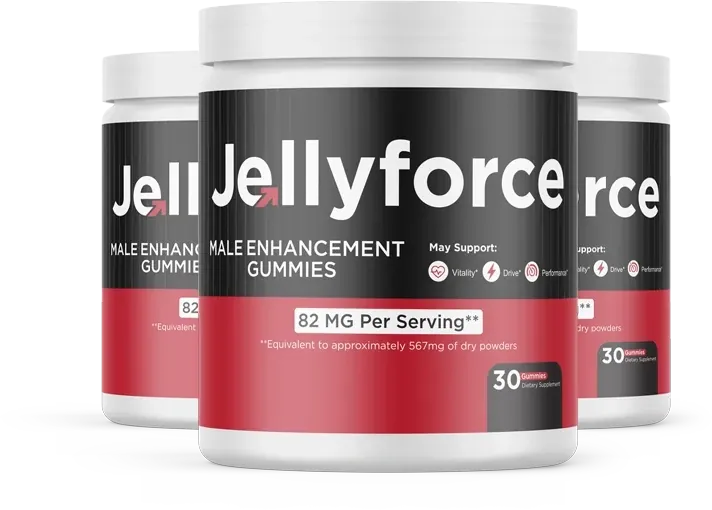
Jelly Force's jar sidesteps that particular trick: it holds 30 gummies, published listings describe the serving as one gummy, and a jar lasts a month at one a day. That part is easy to check and, on this product, checks out cleanly. The harder question is what's actually inside that one gummy, which the next two sections cover.
| What's printed on the jar | What it actually means | What to check before buying |
|---|---|---|
| "60 gummies" alone | Could be a 30-day or a 60-day supply | Find the serving size before assuming the days |
| "1 serving = 2 gummies" | The jar lasts half as many days as the count implies | Divide the gummy count by the serving size, not by 1 |
| 30 gummies, 1 gummy per serving (this jar) | A month's supply, no division needed | Still says nothing about what's in the gummy |
What a combined blend total hides
Where it gets harder is the ingredient number itself. Jelly Force, like a lot of gummies, prints one combined weight for the whole formula rather than a line for each ingredient. On this jar that number is 82 mg per serving.
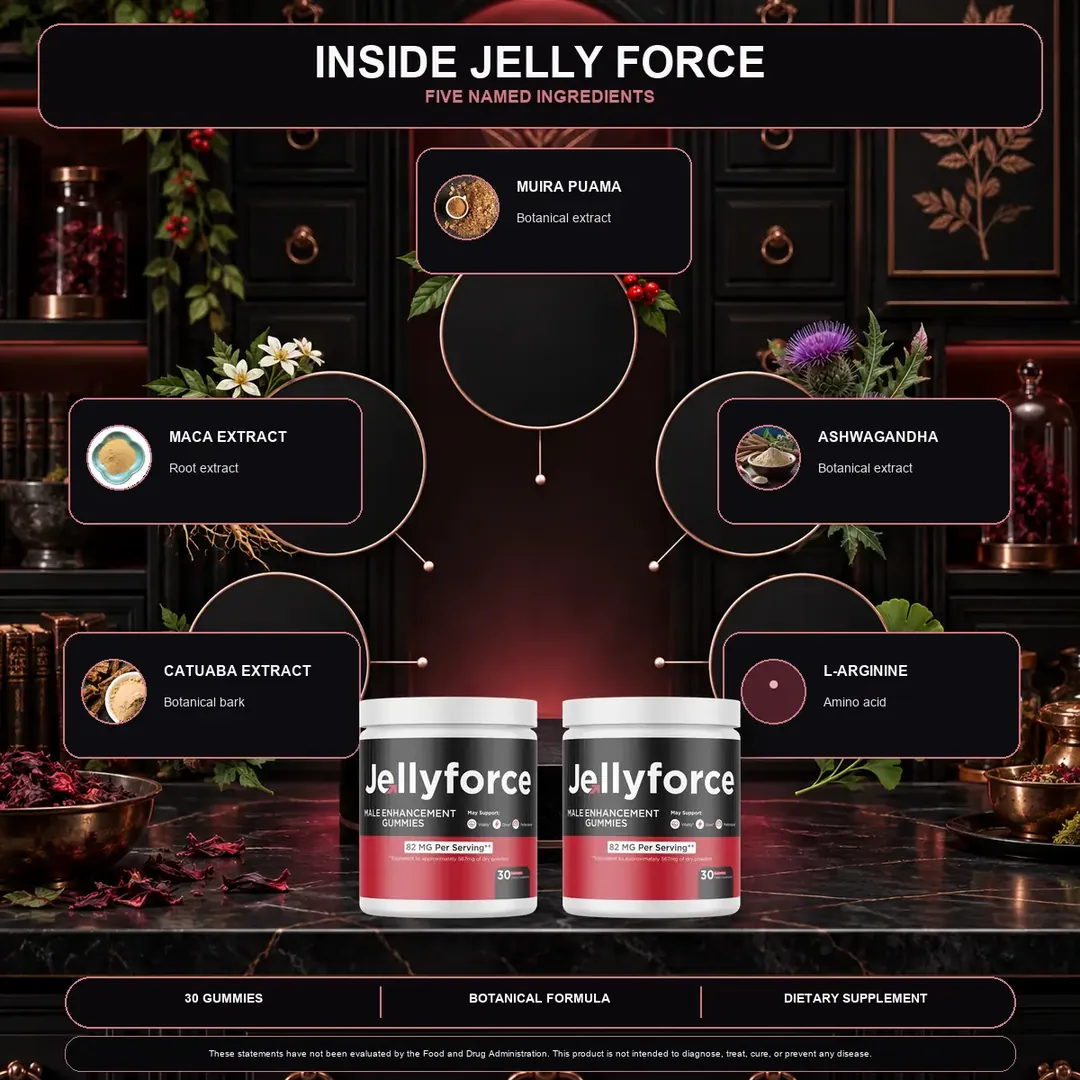
That single figure covers however many botanicals the label names, and the published material for this exact product doesn't even agree on how many that is: the retailer pack names 5, the official sales page names 6, a brand press release names 8, and a published label review names 9. Whatever the actual count, 82 mg is split between all of them, unevenly, in proportions nobody prints.
An amount that isn't published can't be compared to anything, including the research that made a given ingredient worth including in the first place. A trial that used 1,200 mg of one botanical a day tells you nothing about a formula that might contain 40 mg of it, or 4, because the label doesn't say which.
This is usually called a proprietary blend, though the name on the box doesn't change what it does. You can see the size of the whole pie and nothing about how it's sliced. The ingredient printed first is often assumed to be the largest share, but 'often assumed' is not a number, and no number backs it up here either.
The "dry-powder equivalent" footnote
Then there's the footnote, and it's worth reading slowly because it's easy to skim past on the way to the price: "82 MG Per Serving**, equivalent to approximately 567mg of dry powders."
Extracts are concentrated. A gram of dried root and a gram of extract made from that root aren't the same strength, because extraction removes water and fiber and leaves the active compounds behind in less material. Some labels convert an extract's weight into the amount of raw, unprocessed plant it would have taken to produce that much extract. That converted figure is the 'dry-powder equivalent.'
Converting it that direction only ever makes the number bigger. 567 sounds like a lot more than 82, and both are printed in the same breath, with a footnote symbol standing in for an explanation most readers won't stop to look up. Nothing about the conversion changes what's actually in the gummy. It changes how big the number sounds while describing it.

What the bigger number doesn't tell you
- Which of the named ingredients contributed how much of that 567 mg
- What extract ratio was used to do the conversion
- Whether that ratio is a standard one or an estimate
- Whether every ingredient in the blend concentrates the same way when it's converted
Even reading the label at its most generous, using the larger 567 mg figure rather than the 82 mg actually printed as the extract weight, and pretending a single ingredient could claim the whole amount for itself, that number still sits below the low end of the studied dose for maca, L-arginine or ashwagandha alone, before any other named ingredient takes its share. The full arithmetic, worked five different ways, is on what 82 milligrams buys you.
The sugar nobody prints a number for
A gummy is candy with a supplement inside it, and the ingredient list says so once you look past the botanicals. Published listings for this product name corn syrup, cane sugar, water, apple pectin, sorbitol liquid, natural flavors, citric acid and sodium citrate dihydrate as the other ingredients: the part of the formula that isn't a botanical at all, and the part that makes up most of the gummy's actual weight.
None of that is unusual for the format. Gummies need sugar or a sugar substitute to hold together, taste like something, and not turn into a solid brick sitting in the jar. What's worth noticing is that no sugar-per-gummy figure appears anywhere we could find on this product, which means anyone watching their sugar intake, including anyone managing diabetes, has no printed number to work from either. That's worth asking about directly, especially since blood sugar is itself one of the ordinary, treatable causes behind the symptom this kind of product is marketed toward. More on that connection is on why that's a doctor question rather than a shopping question.
The one question worth asking
Once you've read enough of these labels, the useful move stops being 'read more labels' and becomes 'ask one specific question.' When a product publishes a single combined total instead of a full panel, the question is: how many milligrams of the one ingredient I actually care about is in here?
Not the blend total. Not the dry-powder equivalent. The amount of the specific botanical, on its own, that made buying this worth considering in the first place. A company that can answer that has the number and chose a format that doesn't show it. A company that can't answer it doesn't have a number to give, whatever the front of the jar promises.
Either answer tells you something real. U.S. et al., 2026 makes a related point about labels in this category generally: words like 'herbal' or 'all natural' don't guarantee anything about dose, purity or testing, and a claim about where something was manufactured isn't the same as an approval. A specific number, or the lack of one, tells you more than any word printed on the front of a jar. What that gap looks like for this exact product is laid out on what is actually in it and the supplement facts page.
Questions readers ask
Why does serving size matter more than the gummy count?
Because the gummy count alone doesn't tell you how long a jar lasts. A 60-gummy jar at 2 gummies a serving is a month's supply, the same as a 30-gummy jar taken one a day.
What exactly is a proprietary blend?
A single combined weight covering several ingredients at once, with no individual amount printed for any of them. You can see the total and not the split.
Is a dry-powder equivalent figure inaccurate?
Not necessarily false, but it's the larger of two numbers that describe the same material, and it's the one that gets the bigger, bolder placement on the jar.
Does this product say how much sugar is in each gummy?
Not that we could find. Sugar-type ingredients are named on published listings, but no per-gummy sugar amount is printed anywhere we hold.
What should I actually ask a company that only publishes a total?
Ask for the milligram amount of the specific ingredient you're interested in, not the blend total or the dry-powder figure. Their answer, or their refusal to answer, both tell you something.
Why does this product's own ingredient list keep changing between sources?
Four published sources describe it differently: 5, 6, 8 and 9 named ingredients respectively. Nobody has resolved that in writing, which is itself worth knowing before you buy.
Does a bigger milligram number always mean a stronger dose?
No. It can mean a different unit of measurement, like a dry-powder equivalent instead of the extract actually used. Always check what the number is measuring before comparing it to anything else.
Keep reading
What 82 milligrams buys you
The arithmetic behind an 82 mg, 567 mg dry-powder-equivalent supplement serving, worked five ways against each named ing...
Read →Why ED is a doctor question
Why new or worsening erectile difficulty is worth a doctor's visit first: the vascular explanation, common causes, and w...
Read →How much does Jelly Force cost?
Pack sizes, days of supply and how to pick the right one.
Read →Order Jelly Force from the authorized retailer
60 servings per bottle, 1 to 2 droppers a day. Kits of 2, 3 or 6 bottles run from $49 a bottle on the sales page, with a 60-day money-back guarantee. Questions first? Call +1 (302) 200-3480.